
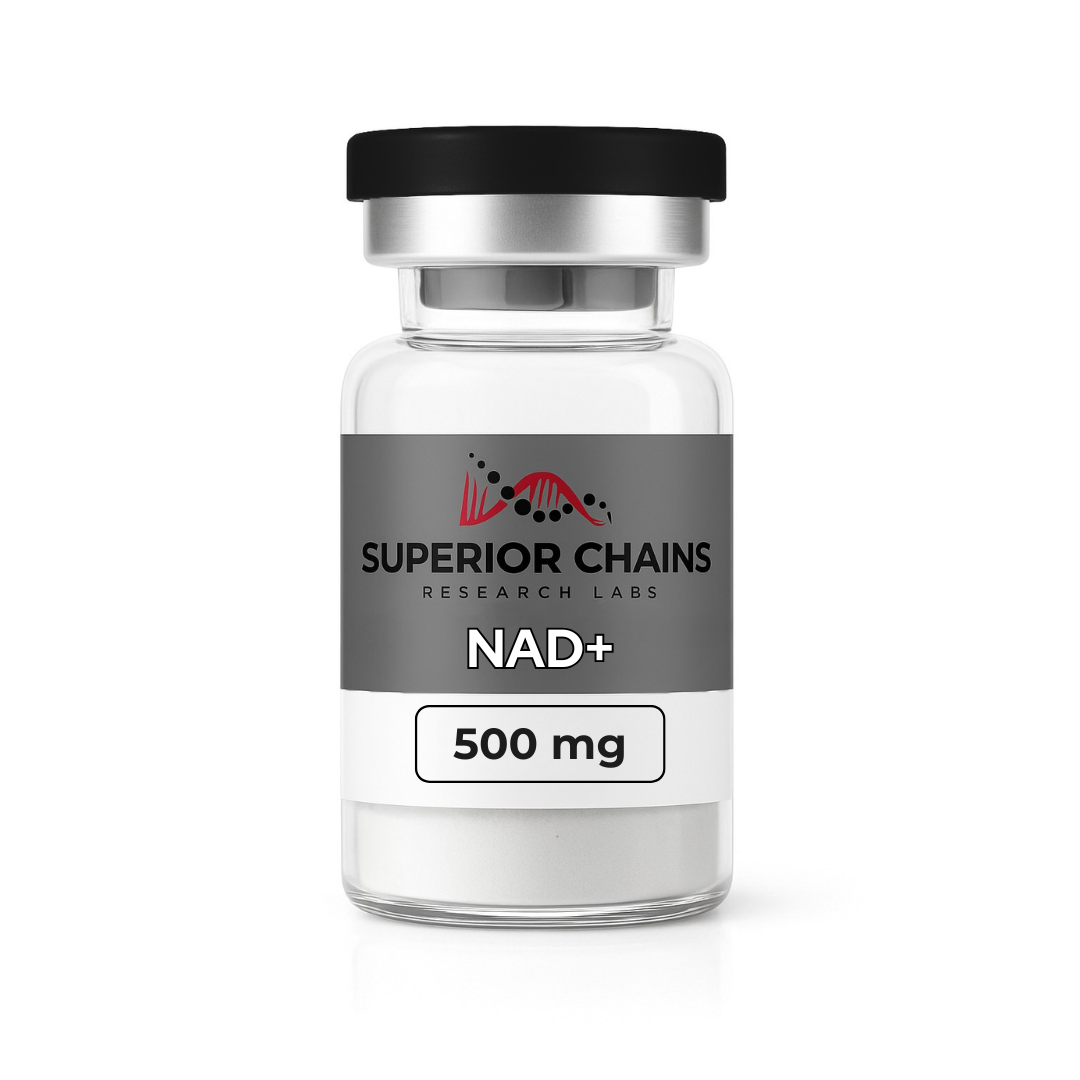
NAD+ 500 mg
$54.99
NAD⁺ (Nicotinamide Adenine Dinucleotide) is a coenzyme widely studied in laboratory environments for its role in cellular metabolism, mitochondrial energy production, and redox signaling pathways.
• 500 mg research compound
• Purity ≥99% (HPLC)
• Nicotinamide adenine dinucleotide coenzyme
• Intended for laboratory research use only – not for human or veterinary consumption
NAD+ 500 mg
Product Overview
Research Context
NAD⁺ (Nicotinamide Adenine Dinucleotide) is a coenzyme found in all living cells and plays a central role in cellular metabolism and energy production pathways. In laboratory environments, NAD⁺ is frequently studied due to its involvement in redox reactions, cellular energy transfer, and metabolic regulatory processes.
Researchers commonly examine NAD⁺ in experimental models exploring mitochondrial function, cellular energy metabolism, and enzymatic signaling pathways. Because NAD⁺ participates in numerous biochemical reactions, it has become an important molecule in research investigating how cells regulate energy balance and maintain metabolic stability.
Laboratory investigations involving NAD⁺ often focus on areas such as:
• Cellular redox reactions and metabolic signaling pathways
• Mitochondrial energy production mechanisms
• Enzyme activity associated with NAD-dependent reactions
• Cellular communication related to metabolic regulation
• Molecular pathways involved in energy transfer within cells
Due to its central role in cellular metabolism, NAD⁺ remains a compound of significant interest to researchers studying how cells regulate energy production and maintain biochemical balance within complex biological systems.
This material is supplied strictly for controlled laboratory research applications and must be handled by qualified professionals in appropriate research environments.
Research Highlights
NAD⁺ has been examined in a wide range of experimental models investigating cellular metabolism and biochemical energy transfer processes. Research interest often focuses on how this coenzyme participates in redox reactions and enzymatic pathways responsible for cellular energy regulation.
Key areas of laboratory investigation have included:
• Cellular redox signaling – studies examining how NAD⁺ participates in oxidation–reduction reactions that support metabolic processes.
• Mitochondrial energy metabolism – research exploring the role of NAD⁺ in biochemical pathways responsible for cellular energy production.
• NAD-dependent enzyme activity – investigations into how enzymes that rely on NAD⁺ regulate metabolic signaling pathways.
• Cellular metabolic communication – laboratory studies evaluating how NAD⁺ contributes to communication between metabolic pathways within cells.
• Biochemical energy transfer mechanisms – experimental work examining how coenzymes such as NAD⁺ participate in complex cellular energy systems.
Scientific Research Information
Peptides and research compounds supplied by Superior Chains Research Labs are intended strictly for laboratory and analytical research applications. Many compounds offered within this catalog are studied in experimental environments investigating molecular signaling pathways, receptor interactions, cellular communication mechanisms, and biochemical regulatory systems.
Researchers frequently utilize synthetic peptides and laboratory compounds when examining:
• peptide–receptor signaling pathways
• intracellular communication mechanisms
• metabolic and regulatory signaling networks
• enzyme activity and biochemical pathway interactions
• cellular stability and molecular signaling systems
Because peptide molecules function as biological messengers within complex cellular systems, they remain an important focus of modern biochemical and molecular research. Laboratory-grade peptides allow researchers to study how these signaling molecules interact with receptor systems and participate in regulatory communication pathways.
All products distributed by Superior Chains Research Labs are supplied exclusively for controlled laboratory research purposes and must be handled by qualified professionals within appropriate research environments.
NAD+ is a synthetic research peptide supplied for laboratory use only.
This product is intended for qualified researchers and controlled laboratory settings.
It is not approved for human or veterinary use, medical applications, or diagnostic purposes.
Specifications
| Product Name | NAD+ |
| Chemical Name / Sequence | |
| CAS Number | 151411-04-0 |
| Molecular Formula | C21H27N7O14P2 |
| Molecular Weight | 663.43 g/mol |
| Purity | ≥ 99% (HPLC) |
| Form | Lyophilized powder |
| Quantity | 10 mg |
Storage & Stability
- Recommended storage: -20°C / -4°F protected from light and moisture.
- Short-term storage after reconstitution: 2–8°C / 35-46°F for up to 8 weeks.
- Avoid repeated freeze–thaw cycles.
- Do not freeze after reconstitution.
Refer to the Certificate of Analysis (COA) for lot-specific stability and handling guidance.
Documentation
Handling & Safety
- Use appropriate personal protective equipment (PPE) when handling.
- Handle in a controlled laboratory environment.
- Dispose of unused material in accordance with local regulations and institutional protocols.
Be the first to review “NAD+ 500 mg”
Related products
Reviews
There are no reviews yet.